Building Strong Foundations Across New York City

Helping property owners with their projects, solving issues efficiently, and delivering dependable, high-quality construction service.

Building Strong Foundations Across New York City
Helping property owners with their projects, solving issues efficiently, and delivering dependable, high-quality construction service.
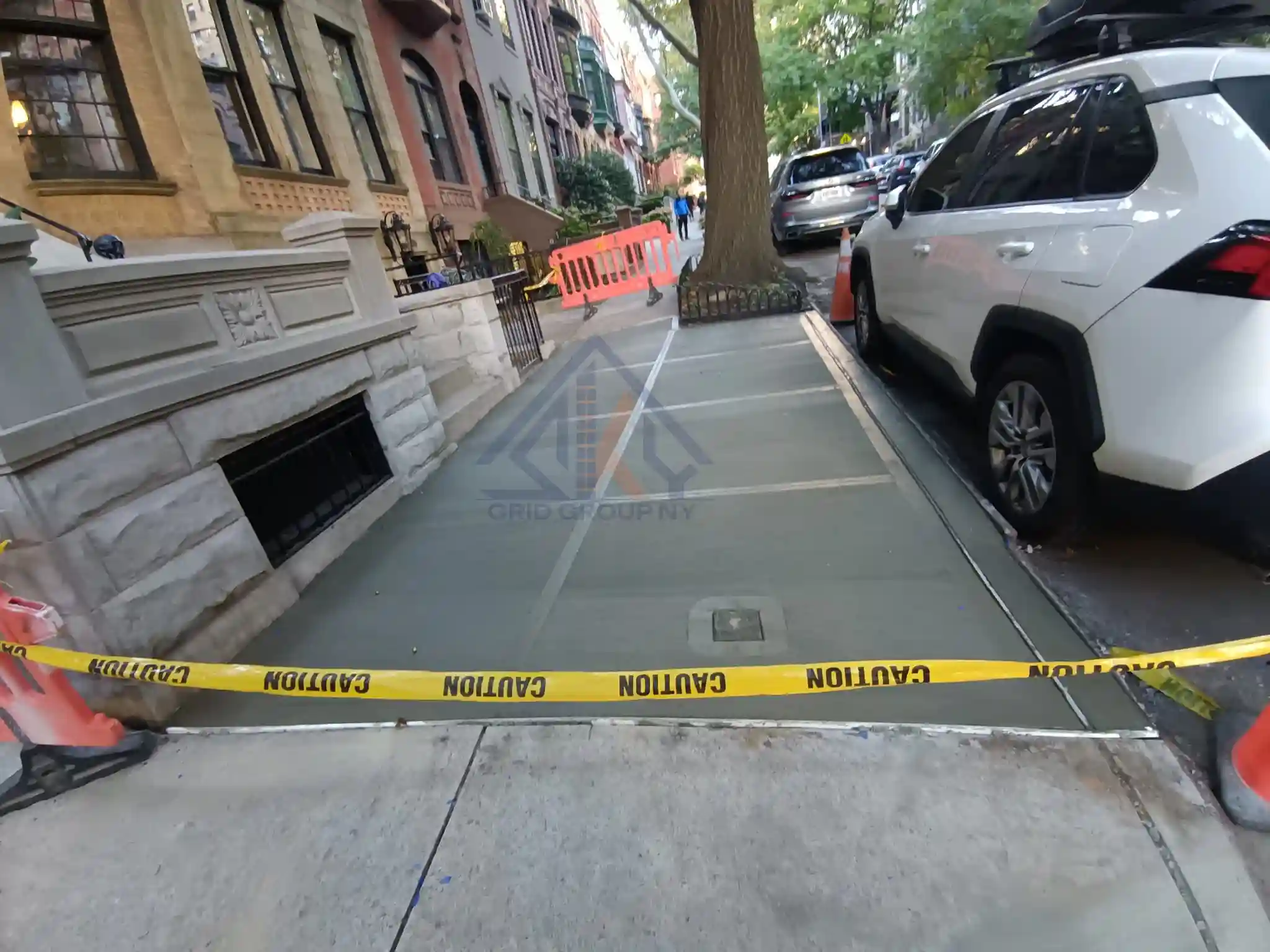
Most NYC sidewalk repairs cost between about $950 and $3,000. Angi's 2026 New York data puts the average at $1,975. A single flag usually runs $300 to $800, a multi-flag violation job lands in the low thousands, and the DOT permit adds $70.
What moves the number is the type of repair, how many flags are marked on your inspection sketch, what's under the concrete, and whether you hire a contractor or let the city do the work. When the city does it, the bill comes from the Department of Finance with up to 20 percent in administrative charges, and interest starts after 90 days.
Note: Prices are market benchmarks, not a quote. The only way to precisely price your sidewalk is to look at it.
Start with how much concrete has to come out. A standard NYC sidewalk flag is 5 by 5 feet, or 25 square feet, so the flag count on your inspection sketch tells you roughly where you land.
| Area | Flags (approx.) | Typical total cost |
|---|---|---|
| 50 to 150 sq ft | 2 to 6 | $500 to $1,500 |
| 200 to 300 sq ft | 8 to 12 | $1,500 to $4,000 |
| 400 to 500 sq ft | 16 to 20 | $3,000 to $8,000 or more |
Small jobs cost more per square foot than the table suggests. The permit, hauling, and crew mobilization cost about the same for one flag as for three, so NYC contractors commonly quote a single flag at $300 to $800.
Prices differ a lot by method, and not every method is accepted if you have a violation. DOT's position is that every flag numbered on the violation sketch must be replaced.
| Repair type | Typical NYC cost | Does it clear a violation? |
|---|---|---|
| Crack and joint sealing | $3 to $8 per sq ft | No. Only works before a flag becomes a defect |
| Protective sealing | $2 to $6 per sq ft | No. Prevention only |
| Patching | $5 to $12 per sq ft | No. Partial-depth patching is itself a defect |
| Grinding a trip hazard | $6 to $12 per sq ft | Not for flags numbered on the sketch |
| Slab leveling (mudjacking) | $5 to $25 per sq ft | Not for flags numbered on the sketch |
| Full flag replacement | $8 to $20 per sq ft | Yes |
| Small slab replacement | $1,500 to $4,000 or more | Yes |
| Bluestone replacement | $25 to $50 per sq ft | Yes, with distinctive sidewalk review |
Per-square-foot pricing from NYC contractors often lands higher than Angi's range, around $15 to $25 for full replacement, once permit handling, demolition, and hauling are folded in.
The cheap fixes still have a place. Sealing a hairline crack or grinding a small lip before DOT cites the flag can keep a minor problem from becoming a violation. After the notice arrives, replacement is what closes it.
A replacement quote is built from a handful of pieces:
| Component | Typical cost |
|---|---|
| Demolition and removal | $3 to $8 per sq ft |
| Disposal and hauling | $120 to $180 per ton |
| Labor, non-union crews | $70 to $110 per hour |
| Labor, union rates (effective) | $100 to $160 per hour |
| DOT sidewalk permit | $70 per 300 linear feet |
| New concrete, forming, and finishing | Rolled into the per-sq-ft rate |
Most residential jobs are quoted at a flat rate, not hourly, but the labor numbers explain why NYC runs above national averages.
Access explains the rest. There's often no street parking for a work truck, concrete delivery has to be scheduled around size and weight limits, and crews hand-carry material down narrow lots. Busy pedestrian blocks may need barriers, signage, and a flagperson, and all of that ends up in the quote.
The permit is small next to the repair, but it isn't optional for most work. For the full process, see our NYC sidewalk permits guide.
| Item | Cost | Notes |
|---|---|---|
| Sidewalk Construction Permit | $70 | Covers up to 300 linear feet for one property, valid 30 days |
| Corner or through-lot property | $70 per additional permit | Multiple permits may be needed when both frontages are repaired |
| Occupancy of Sidewalk permit | $50 | When less than 5 feet of clear walkway remains |
| Crossing Sidewalk permit | $50 | Vehicles or equipment crossing the sidewalk |
| Curb repair or replacement permit | $135 | Curb work in the roadway, valid 30 days |
One more cost rule: any contractor doing sidewalk repair that costs more than $200 needs a Home Improvement Contractor license from the Department of Consumer and Worker Protection. DOT suggests verifying it in DCWP's public database. Sky Grid Group NY lists DOT, DOB, and DCWP licensing.
The same square footage can price very differently depending on what kind of job it is.
| Type of work | Rule that applies | Effect on cost |
|---|---|---|
| Repair tied to a violation | Permit required at any size. Every numbered flag must be replaced. The permit does not extend the 75-day window | Scope is set by the sketch, not by what looks bad |
| Corner properties | Multiple permits may be needed | An extra $70 per frontage, plus ramp work if the corner is touched |
| Driveway aprons | DOT prices driveway areas at 7-inch concrete, versus 4-inch for a standard sidewalk | Thicker pour, higher cost |
| Tree-root damage | Parks Tree Work Permit within 50 feet of a city tree. Cutting city tree roots is prohibited | Root work adds cost, but eligible owners may pay nothing |
| Defective curbs | DOT may replace curbs at no cost during violation-related work | Bundling can save money |
| Sidewalk over a vault | The owner repairs privately. The city won't. A DOB-approved plan is required | Much higher. Full vault replacement runs about $200 to $250 per sq ft |
| Bluestone and other distinctive materials | Additional review before construction. LPC approval in historic districts | $25 to $50 per sq ft |
| Certain commercial districts | Pigmented concrete is required when replacing more than 50 percent of the sidewalk in front of a lot | Extra material cost |
A few of these deserve a closer look.
Trees. Owners of one-, two-, and three-family properties aren't charged when a city street tree is the sole cause of the damage, and NYC Parks runs a Trees and Sidewalks Program for those repairs. The city no longer issues violations or liens in those cases. If roots are involved, find out before paying for a repair that may not be yours.
Curbs. DOT can repair or replace missing and defective curbs at no cost when it's doing violation-related sidewalk work. Our curb repair page covers the private side, and we explain who pays in is the city responsible for curb repair.
Driveways. If the damaged area includes a driveway apron, expect a thicker pour. See driveway repair for that scope.
Vaults. Many older Manhattan and Brooklyn buildings have a basement vault running under the sidewalk. If the damaged section sits over one, the structure under it may need work first. RAND Engineering & Architecture puts a full vault replacement at roughly $200 to $250 per square foot, before engineering fees.
The permit is the same in every borough. Labor, access, and disposal are not.
| Borough | What tends to drive cost |
|---|---|
| Manhattan | Tight staging, truck size and weight limits, delivery windows, heavy foot traffic, and more vaults and landmarked blocks |
| Brooklyn | Brownstone blocks with narrow access and bluestone sidewalks, plus mature street trees |
| Queens | Wide mix of single-family blocks and busy commercial corridors, with tree-root damage common |
| Bronx | Older housing stock and aging concrete, with a similar range to Brooklyn and Queens |
NYC contractor pricing pages commonly quote about $15 to $20 per square foot for full replacement in Brooklyn, Queens, and the Bronx, with Manhattan running higher. Sky Grid Group NY works in Brooklyn, Queens, the Bronx, and Manhattan.
A DOT violation has no fine. It's a notice to repair, and you have 75 days from the day you receive it (or the day it's posted on the property). The cost shows up if that window closes. We cover that deadline in what happens after 75 days.
If it does, DOT can send a contractor, and the Department of Finance bills you. The bill is worked out like this:
You then have 90 days to pay before interest is added and a lien is placed on the property.
| Property type | Annual interest on the unpaid bill |
|---|---|
| Assessed value over $250,000, or vacant land | 18% |
| All other properties | The lesser of 8.5% or the city's cost of servicing the debt |
A payment plan is available to eligible owners of certain residential properties. DOT's own page explains the process, and the city's contractor guarantees its work for 18 months. NYC contractors often describe city-billed repairs as two to three times private pricing. That's a contractor claim, not a city figure, but the letter with your notice lists the city's rate, so you can compare it with a private quote before the deadline.
A city-billed repair in Bushwick. A PIX11 investigation followed homeowners on Bushwick Avenue who were cited after a 2018 inspection. The city's contractor didn't arrive until late 2019, and the charges appeared on their November 2020 property tax bills. One homeowner was billed just over $2,200. Her neighbor, whose sketch marked nine squares, was billed $3,121. She said a private contractor who had worked on her porch told her he'd have charged $500 to $600 for that kind of work. DOT's response was that violations aren't issued to raise revenue. Details like that are why it's worth reading the sketch carefully and requesting a re-inspection within 75 days if it doesn't match your sidewalk.
Hardship that changed the rules. In 2019, city officials said homeowners facing repairs of $1,000 to $3,000 were being hit with liens that blocked refinancing or a sale, which led to the current exemption for damage caused solely by city trees.
Illustrative math for a four-flag violation. Four flags is 100 square feet. Angi's size table puts 50 to 150 square feet at $500 to $1,500. Per-square-foot replacement pricing of $8 to $20 points to $800 to $2,000. Where those overlap, roughly $800 to $1,500, is a reasonable expectation, plus the $70 permit. Treat this as a worked example, not a quote.
DOT publishes a few hard numbers. The rest comes from NYC contractors.
| Stage | Typical duration | Basis |
|---|---|---|
| Notice received | The 75-day clock starts at receipt or posting | DOT |
| Estimate and site visit | 1 to 3 days | Contractors |
| Permit approval | 1 to 2 business days once filed, longer with holds | DOT |
| Work on site | 1 to 3 days for most residential jobs | Contractors |
| Curing | Several days, though some crews wait up to 28 days before the inspection | Contractors |
| Dismissal inspection | Requested through 311 after the work, DOT sends an inspector | DOT |
| Whole process | 2 to 4 weeks is common, 6 to 8 weeks if a full cure is waited out | Contractors |
A few things stretch it. A Parks tree permit usually takes about 45 days, Landmarks approval has to come before DOT, and holds or embargoes can delay a permit. Weather matters for pours, but DOT doesn't extend the 75 days for it, and the window is the same all year.
If you think the notice is wrong, you can ask for a re-inspection within 75 days. DOT schedules it within 180 days of the appeal, a different inspector does it, and the result is final. DOT's Expedited Sidewalk Repair Program is currently paused, so don't count on it.
| Stat | Figure | Source |
|---|---|---|
| Miles of sidewalk in NYC | 12,000+ | NYC DOT |
| Sidewalk replaced by the city each year | 2+ million sq ft, mostly on city-owned property | NYC DOT |
| Sidewalk injury claims against the city, FY2023 | 2,350, the third most frequent personal injury claim type | NYC Comptroller |
| Paid to settle those claims, FY2023 | $53.5 million | NYC Comptroller |
| Average NYC sidewalk repair cost | $1,975 (most homeowners $949 to $3,023) | Angi |
| Return on investment for exterior repairs | 60% to 85% | Angi |
| Time to fix after a notice | 75 days | NYC DOT |
| Time to pay a city repair bill before interest | 90 days | NYC DOT |
The claims figures cover claims against the city. Owners face their own exposure under Administrative Code § 7-210, which makes them potentially liable for injuries caused by a poorly maintained sidewalk. The Comptroller's FY2023 Annual Claims Report has the full numbers.
For a starting figure, use our free estimate calculator. For an actual price, send us your violation notice and inspection sketch and we'll price the flags marked on it. See our sidewalk repair page for what we handle, or contact us or call (718) 814-1129.
Most jobs run about $950 to $3,000, with an average around $1,975 according to Angi's 2026 New York data. Larger or more complex jobs can exceed that, and a single flag usually costs $300 to $800.
A standard 5 by 5 foot flag is 25 square feet. At $8 to $20 per square foot that's $200 to $500 in materials and labor, but small jobs carry fixed costs for the permit, hauling, and mobilization, so single-flag quotes commonly land at $300 to $800.
It depends on how many flags are numbered on your inspection sketch. A typical residential violation covers a handful of flags and lands in the low thousands, plus the $70 permit.
No. DOT says a violation carries no fine. The cost arrives if the 75 days pass and the city does the repair and bills you.
The bill is the square footage on your sketch times the per-square-foot rate on your notice letter, plus up to 20 percent in administrative expenses. You then have 90 days to pay before interest and a lien apply.
$70 for up to 300 linear feet of sidewalk for one property, valid for 30 days. Corner and through-lot properties may need more than one.
Work on site usually takes one to three days. Including the permit, curing, and the dismissal inspection, most violation repairs take two to four weeks, longer if the crew waits out a full cure or a tree permit is involved.
Usually not. The city does not accept requests to repair your sidewalk. The main exceptions are damage caused solely by a city tree on a one-, two-, or three-family property, damage caused by a city contractor, and defective curbs DOT replaces during violation-related work.
Not if the flag is numbered on a violation sketch. DOT says every numbered flag must be replaced, and partial-depth patching is a defect of its own. Grinding and sealing make sense before a flag is cited.
Yes for anything over $200. Sidewalk repair above that amount requires a Home Improvement Contractor license from DCWP, and the contractor taking out the sidewalk permit must be registered with DOT. Homeowners repairing their own sidewalk are the exception.
Eligible owners of certain residential properties can apply for a Sidewalk Repair Payment Plan through the Department of Finance or 311.
If you have a violation, a lifted flag, or a corner lot with more work than you expected, get a free estimate or call (718) 814-1129. We'll tell you what the sketch requires, what it should cost, and how long it will take.