Building Strong Foundations Across New York City

Helping property owners with their projects, solving issues efficiently, and delivering dependable, high-quality construction service.

Building Strong Foundations Across New York City
Helping property owners with their projects, solving issues efficiently, and delivering dependable, high-quality construction service.
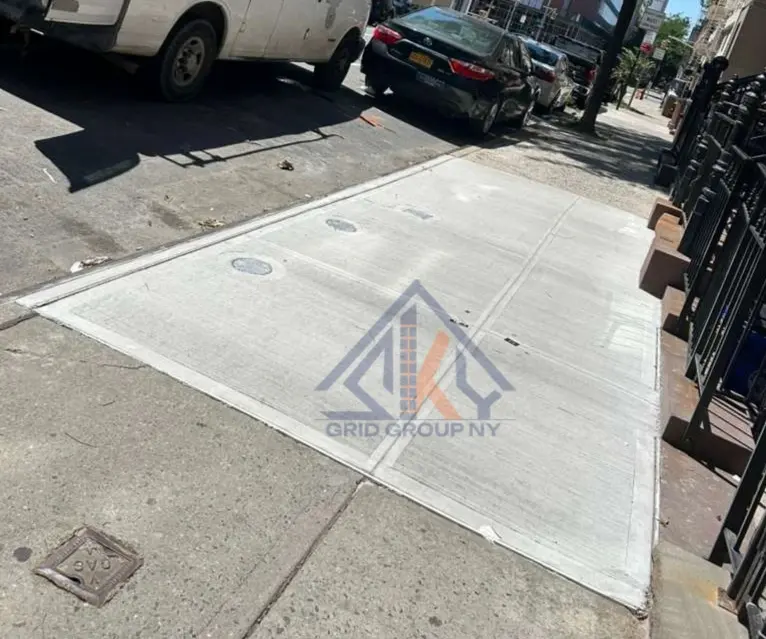
If you have missed the 75-day deadline on a NYC DOT sidewalk violation, the city can hire its own contractor, fix your sidewalk, and send you the bill. The violation itself carries no fine, but that bill turns into a lien on your property if it goes unpaid, potentially restricting you from selling or refinancing your property. So the deadline is not really a penalty date. It is the last day you get to pick the contractor, the schedule, and the price.
When DOT inspectors find an unsafe sidewalk, the property owner receives a Notice of Sidewalk Violation. As per the New York City administrative codes, the owner then has 75 days to make the repair. The city says the notices exist to encourage owners to fix sidewalks for public safety, and it stresses that no fine comes attached.
The responsibility itself comes from Section 19-152 of the Administrative Code, which puts the job of installing, repairing, and maintaining the sidewalk on the owner of the adjoining property. If you own a corner lot, that includes the intersection quadrant and pedestrian ramps too.
A copy of the violation is then filed with the County Clerk and stays there until the city confirms satisfactory repairs. DOT notes that an open violation can complicate selling or refinancing a property. Buyers and lenders tend to want clean records, and a sidewalk issue is an easy thing to trip over during a closing.
Then there is liability. Section 7-210 makes owners potentially liable for injuries caused by a failure to maintain the sidewalk in reasonably safe condition. The law exempts one-, two-, and three-family homes that are at least partly owner-occupied and used only for residential purposes. If your property does not fit that description, an ignored violation sits on record while pedestrians keep walking past the defect.
The 75 days begin when you receive the notice, as shown on the certified mail receipt. If the notice was not delivered by mail, it gets posted on the property, and the posting date starts the count. The city also states that the period is the same all year, so a winter violation does not buy you extra time. You are expected to schedule a contractor as soon as the weather allows.
One more thing trips people up: a permit does not extend the deadline. Per DOT's guide, you or your contractor must take out the permit and begin repairs within the 75 days.
If you fully ignore the notice and leave your sidewalk unaddressed after the deadline passes, DOT may step in and perform the repair itself by hiring a contractor to do it. The word "may" matters here. The city is not obligated to show up on day 76. In 2023 testimony to the City Council, DOT reported that fewer than one percent of city repairs in the previous five construction seasons happened within 90 days of a notice. Still, counting on that delay is a gamble, and the testimony is clear that the authority is there.
DOT says you will receive formal notice before any city crew starts work. From there, the process moves in three steps:
A city consultant or representative photographs the sidewalk to record its condition.
The flags that need replacing get marked, and every flag numbered on your Preliminary Inspection Report (PIR), the sketch that came with the violation, must be replaced
The city's contractor completes the work, and DOT then tells the County Clerk to remove the violation from the record
You have no say in who does the job, when it happens, or how it is carried out. The DOT also notes that the contractor's work is guaranteed for 18 months from the end of the contract period.
You can estimate the total before it arrives. Take the square footage listed on your PIR and multiply it by the per-square-foot rate printed in your violation letter. Driveway areas use the seven-inch concrete rate, and everything else uses the four-inch rate. Keep in mind the final bill can be higher, since it may cover extra work needed to clear every defect.
Check your PIR sketch for any flag marked with an "X." DOT may replace those at no charge, and a Department of Design and Construction (DDC) engineer makes that call on site. For a sense of scale, one local cost breakdown puts typical private sidewalk repair in New York City between $5 and $15 per square foot, though your scope, borough, and site access will move that number.
Once the sidewalk repair work is done by the city. The Department of Finance then sends the invoice, which includes the repair cost plus 20% administrative cost. You have 90 days to pay that bill before interest is added. If the balance stays open after that, interest accrues and a monetary lien goes on the property, which is collected much like other municipal debts and can get in the way of a sale or refinance.
A large bill does not have to land all at once. Finance lets eligible owners convert the charge into four annual installments. Per the Finance application form, you qualify when all of these are true:
• You apply within one year of the date the charge was entered
• The charge is more than $250 and no more than $5,000
• The property is a one- to six-family home, or its assessed value is $30,000 or less
The first installment is due when the application is approved, and the remaining three come due on each anniversary of the original charge. Interest runs at 8.5 percent a year or the city's borrowing rate, whichever is lower. Download and mail the form to Finance, or get help at a Finance Business Center or through the 311 Sidewalk Repair Payment Plan option.
If the quality of the repair, the amount of work, or the measurements behind your bill look wrong, DOT lays out a strict three-stage appeal. Each stage has to happen in order, or the appeal does not count:
Start with the DDC, through 311 or its website. Phone calls and walk-ins are not treated as appeals.
If the DDC's answer does not satisfy you, file a Notice of Claim with the Office of the Comptroller. DOT's guide says this must happen within one year of receiving the bill.
Still unresolved? File a petition with the Small Claims Assessment Review Part of the New York State Supreme Court, but only after 30 days have passed since the claim was filed without a decision or with a denial. The County Clerk's office provides the forms free of charge.
Not every violation plays out the same way. A few situations change the picture:
Tree roots: DOT stopped issuing violations to one-to-three family properties for defects caused entirely by tree roots in 2019. If a City tree caused the damage, the property may qualify for the Parks Department's Trees and Sidewalks Program.
Flags marked with an "X": If a flag on your PIR carries an X, DOT may replace it at no charge to you, based on a DDC engineer's decision at the time of construction.
Vaults: If the damaged section sits over a vault, the city will not repair it. You must handle it privately, and the structural work can be substantial.
Whichever side of the deadline you are on, the sequence is the same.
Compare the PIR with your property. Look at the width, trees, signs, utility caps, and cellar doors. If they do not match, you can request a re-inspection through 311 within 75 days of receiving the notice. DOT will schedule it within 180 days. A different inspector, who has no access to the first report, does the visit, and you get a mailed notice at least five days ahead. That inspection is final.
Pick a licensed company who knows DOT specifications for sidewalk work. DOT points owners to the Department of Consumer and Worker Protection's licensed contractor database, which also shows complaint history.
A sidewalk permit currently costs $70 for every 300 linear feet of sidewalk on one property, and corner or through lots may need more than one. Contractors apply through nycstreets.net. Homeowners doing their own work can apply by mail with an application, a notarized Affidavit of Ownership, and a certified check.
When the work is done, contact 311 for a Sidewalk Violation Dismissal Inspection. Have your permit number, address, block and lot, violation number, and contact details ready, and keep the entire sidewalk visible for the inspector. If you are already past day 75, ask 311 for your violation's status first so you know where the case stands before you hire anyone.
Photograph the finished sidewalk from a few angles, and keep your permit, the contractor's invoice, and the dismissal confirmation in one folder. If a buyer's attorney or a title search ever asks whether the violation was cleared, you will have proof on hand instead of a phone tree to navigate.
Seventy-five days sounds generous until you factor in getting quotes, waiting on permits, and scheduling around weather. Every week you spend deciding is a week off the clock, and the city's version of the job will not be tailored to your budget. If a violation notice just landed on your doorstep, Sky Grid Group NY can help you sort out the next move. Reach out to our certified crew and let them review your Preliminary Inspection Report, get a repair plan built around DOT specifications, and keep your sidewalk work moving well before day 75 arrives.