Building Strong Foundations Across New York City

Helping property owners with their projects, solving issues efficiently, and delivering dependable, high-quality construction service.

Building Strong Foundations Across New York City
Helping property owners with their projects, solving issues efficiently, and delivering dependable, high-quality construction service.
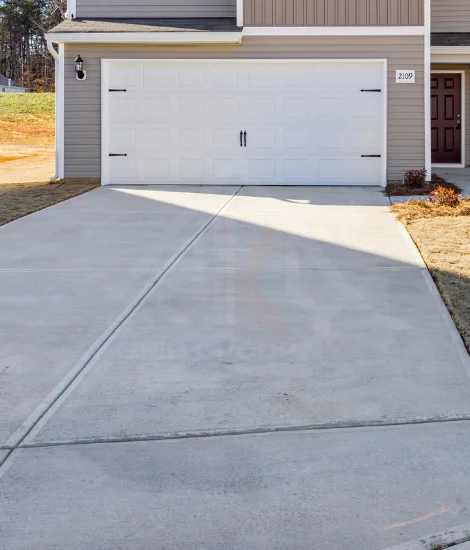
In New York City, you can't just pave a driveway and cut down the curb. A legal driveway needs a Department of Buildings (DOB) curb cut permit filed by a licensed engineer or architect, sidewalk and curb permits from DOT, and a curb cut that meets zoning limits for width and distance.
Skip that and you can end up with Environmental Control Board (OATH) violations, often several at once, that sit on the property record and can block a sale or refinance until they're cleared. Drivers have their own set of fines: $95 for parking in front of a driveway, $115 for parking on the sidewalk.
Last updated: October 2026. Zoning limits vary by district, so confirm your lot's numbers with a licensed engineer or architect before you design anything.
A driveway touches several agencies. Knowing which one handles what saves a lot of back and forth.
| Agency | What it controls |
|---|---|
| Department of Buildings (DOB) | Approves the curb cut plans for safety and zoning, issues the work permit, and issues violations for illegal curb cuts |
| Department of Transportation (DOT) | Sidewalk and curb permits, and the construction specifications for the apron and curb |
| Department of City Planning | The Zoning Resolution, which sets curb cut width, location, and spacing |
| Consumer and Worker Protection (DCWP) | Home Improvement Contractor license, required for whoever installs the curb cut |
| Parks | Tree Work Permit for sidewalk work within 50 feet of a city tree |
| Department of Finance | Parking tickets, including driveway-blocking violations |
DOB's own process is short on paper and slower in practice.
NYC contractors typically report about 6 to 12 weeks from first survey to the day you can drive over the new apron. Objections during plan review can add more.
A few build details from DOB's guidance: the curb is dropped to a height of 1.5 inches, the curb reveal has to match the adjacent lots, and existing granite curbs are replaced in kind. Driveway areas use a 7-inch sidewalk, versus 4 inches on a standard sidewalk. For the DOT side of the sidewalk work, see our sidewalk repair page.
DOB lists minimum distances from anything on the sidewalk or curb.
| Obstruction | Minimum distance |
|---|---|
| Trees | 7 feet |
| Fire hydrants | 7 feet |
| Light poles | 7 feet |
| Street signs | 7 feet |
| Utility poles | 7 feet |
| Phone booths | 10 feet |
| Residential zone easements | 5 feet |
| Crosswalks and other right-of-way lines | 5 feet |
| Adjacent driveway edge | Varies with zoning district |
The parking space itself must be at least 8.5 by 18 feet, inside your building lines, and can't encroach on the sidewalk. Driveways serving required parking must be at least 8 feet wide.
Width limits come from the Zoning Resolution and depend on your district. Two examples from the zoning text show the range.
| Rule | Example limit |
|---|---|
| Common low-density districts, lot under 50 ft of frontage | One curb cut, maximum 10 ft wide including splays |
| Common low-density districts, lot 50 ft or wider | Up to two curb cuts, each within the district maximum |
| Maximum curb cut width in those districts | 18 ft |
| Maximum driveway width within a front yard | 20 ft |
| Lower density growth management areas, lot under 33 ft | One curb cut, maximum 10 ft, driveway no wider than 10 ft |
| Lower density growth management areas, lot 33 ft or wider | Multiple curb cuts allowed, at least 16 ft apart; driveways at least 13 ft apart |
Those numbers come from the Zoning Resolution's curb cut sections (see 25-631 for the first group). Which section applies to you depends on your district and neighborhood. Treat these as examples, not your lot's answer.
Front yards have a second rule. Zoning requires planting in parts of the front yard, so paving the whole thing is a cited condition on its own, separate from the curb cut.
The city's fees are small. The design work and construction are where the money goes.
| Item | Cost | Notes |
|---|---|---|
| DOT sidewalk permit | $70 | Covers up to 300 linear feet, valid 30 days |
| DOT curb permit (reset, replace, install, or repair a curb) | $135 | Valid 30 days |
| DOT sidewalk crossing permit | $50 | For vehicles or equipment crossing the sidewalk with no approved curb cut or driveway. Valid 90 days |
| Engineer or architect | Varies | Separate professional fee for the drawings and filing |
| DOB filing fees | Varies | Based on the scope of work |
| Construction | Varies | The 7-inch apron and sidewalk section costs more per square foot than a standard sidewalk |
Be careful with any flat price you see online. Length of the cut, apron thickness, how much sidewalk has to be replaced, and design and filing fees all change the total. Our free estimate calculator gives a starting number for the concrete side.
There are two kinds of fines here, and they hit different people.
DOB issues violations for illegal curb cuts, and they're adjudicated at OATH. Both the contractor and the homeowner who hired them can face violations, court appearances, fines, and civil penalties. Illegal curb cuts usually come with several violations at once, and each one has to be corrected.
| Item | What the city's records show |
|---|---|
| Average penalty per curb cut violation | $572, in the Comptroller's audit of 2016 to 2018 |
| Civil penalties for work without a permit | $600 to $10,000, per the same audit |
| Open violations | Block selling, refinancing, or getting a new Certificate of Occupancy or Letter of Completion |
| Cure window | OATH classes 2 and 3 allow 40 days to cure or contest. Class 1 needs immediate action |
Fixing the condition and paying the fine are separate steps. The usual correction is to restore the original curb or obtain a permit after the fact.
| Violation (DOF code) | Fine |
|---|---|
| Parking in front of a public or private driveway (98) | $95 |
| Parking on a sidewalk (51) | $115 |
| Parking in a crosswalk (50) | $115 |
| Parking within 15 feet of a fire hydrant (40) | $115 |
| Parking in front of a pedestrian ramp (67) | $165 |
One exception to know: you can park your own passenger vehicle in front of your own driveway only if the lot has no more than two dwelling units and the vehicle is registered at that address. Owners of larger buildings can't.
Painting the curb yellow or posting your own no-parking sign is also against the law. Under state law, those violations can be fined up to $250. DOB staff who find them are supposed to refer them to DOT.
In 2021, the NYC Comptroller published an audit of DOB's controls over illegal curb cuts and driveways. It's the best public look at how this plays out.
| Stat (July 2016 to October 2018) | Figure |
|---|---|
| Complaints about illegal curb cuts, driveways, and carports | 5,783, covering 3,874 properties |
| Field inspections | 3,238 |
| Violations issued | 1,435, on 1,203 properties |
| Inspections that ended in a violation | About 31 percent |
Some of the cases the auditors documented:
The audit also found DOB was slow and inconsistent, and DOB says response times have improved since. But slow enforcement isn't a safe harbor. Violations stay on the record, and they can come up years later at a closing.
Plenty of older NYC driveways were built long before today's rules. DOB's position is that existing legal curb cuts are grandfathered and don't have to meet current zoning.
The catch is the word "legal." A driveway being there doesn't prove it was permitted. DOB officials have said that neither a curb cut permit nor a Certificate of Occupancy on file automatically proves a curb cut is legal today, since owners sometimes widen or add cuts afterward.
Before you buy, sell, or repave:
Repairing paving inside your property line is a different job from changing the curb cut. Widening, moving, or adding a cut goes through DOB and DOT. For repair scope, see driveway repair, and for curb work, curb repair.
Who pays for what at the curb isn't always obvious. We cover it in is the city responsible for curb repair.
The permit process is the same citywide, but the zoning answer isn't. Lot width, district, and neighborhood-specific rules decide what's allowed, and some lower-density areas have tighter limits. Sky Grid Group NY works in Brooklyn, Queens, the Bronx, and Manhattan.
If you're creating or changing a curb cut, yes. You need DOB approval and a work permit, plus DOT sidewalk and curb permits. A licensed engineer or architect has to file the DOB application.
A New York State licensed Professional Engineer or Registered Architect. DOB's guidance also lists Registered Landscape Architects. A homeowner can't file it alone.
In the Comptroller's audit, the average penalty per curb cut violation was $572, and illegal curb cuts usually come with several violations. Work without a permit can carry civil penalties from $600 to $10,000. You'll also pay to restore the curb or legalize the cut.
It depends on your zoning district. In some common low-density districts the maximum is 18 feet, with a single cut of 10 feet on lots under 50 feet wide. Other areas are stricter. Ask a licensed professional to check your lot.
At least 7 feet from trees, hydrants, light poles, street signs, and utility poles. It's 10 feet from a phone booth and 5 feet from a crosswalk.
Only if the lot has no more than two dwelling units and your car is registered at that address. Otherwise it's a $95 ticket.
$95 under DOF violation code 98, the same in every borough.
Not automatically. DOB officials have said a CO or curb cut permit on file doesn't by itself prove a curb cut is legal, since it may have been altered afterward.
Sometimes. If it meets zoning, a design professional can apply for a permit after the fact. If it doesn't, the curb has to be restored.
Yes. Open or uncorrected violations prevent an owner from selling, refinancing, or getting a new Certificate of Occupancy or Letter of Completion.
If you're planning a driveway, repairing an apron, or dealing with a violation, get a free estimate or call (718) 814-1129. Sky Grid Group NY is licensed by DOT, DOB, and DCWP. We build to DOT specifications and take care of the sidewalk and curb permits, working with your engineer or architect on the DOB filing.