Building Strong Foundations Across New York City

Helping property owners with their projects, solving issues efficiently, and delivering dependable, high-quality construction service.

Building Strong Foundations Across New York City
Helping property owners with their projects, solving issues efficiently, and delivering dependable, high-quality construction service.
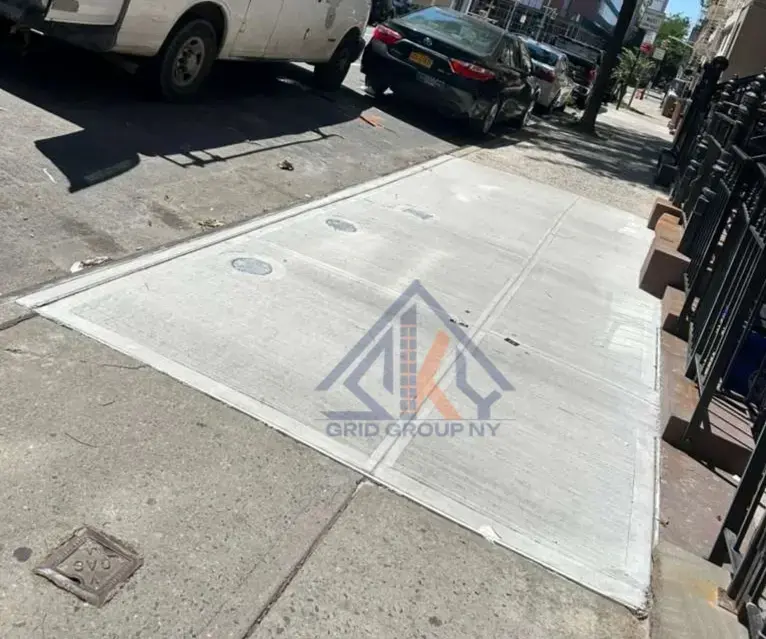
The City of New York owns the sidewalk in front of your building, but in most cases the property owner is the one who has to fix it, clear it, and answer for it if someone gets hurt. NYC DOT says sidewalks, curbs and roadways belong to the City, while the Administrative Code puts the job of maintaining the abutting sidewalk on the property owner.
There are real exceptions, including a liability shield for some small homes and a few stretches of "sidewalk" that are actually private land. Let’s get into it together.
Most confusion starts when people treat these as one question. The title belongs to the City. Responsibility belongs to you. Section 19-152 of the Administrative Code makes owners responsible for installing, repairing and maintaining the sidewalk next to their property, and Section 7-210 makes them potentially liable for injuries caused by a failure to maintain it. In 2023 testimony, DOT told the City Council that all property owners must maintain the sidewalk next to their property and that the agency inspects to enforce it.
Think of it as a public right-of-way with a private maintenance bill attached. Because the sidewalk is City property, you cannot paint the curb to discourage parking, even if you have a driveway. DOT will issue a Notice of Defacement and expect you to restore it. Illegal curb cuts are handled by the Department of Buildings and can bring OATH violations and fines for both the contractor and the homeowner who hired them.
The duty also reaches further than many corner owners expect. Section 7-210 specifically includes the intersection quadrant for corner property.
Section 7-210 does not apply to one-, two-, or three-family homes that are at least partly owner-occupied and used exclusively for residential purposes. For those homes, the City stays liable for sidewalk injuries. Courts read the exemption literally. In Moreno v. Shanker, a four-family certificate of occupancy was not exempt, and a commercial use can also disqualify a building.
The exemption has a limit that catches people off guard. It covers civil liability for injury claims. It does not cancel DOT's repair expectations or Sanitation's snow rules, so a homeowner can still receive a sidewalk violation or a snow summons.
An easement is a right to use land you do not own. The public holds that kind of right over the sidewalk, which is why strangers can walk past your stoop without asking. DOT describes streets and sidewalks as the City's inalienable property, meaning they cannot simply be given away or claimed by a neighbor.
Some sidewalk-looking areas sit on private lots. In certain districts, the Zoning Resolution requires new developments to provide a sidewalk widening on the zoning lot itself. Section 115-31, for example, calls for widenings two or five feet deep where mapped, built to DOT standards, level with the public sidewalk, and open to the public at all times. The land stays private, but the public gets to use it.
You may also notice bronze plaques reading “Crossing by permission only.” These markers generally indicate that the ground beneath or alongside the sidewalk is privately owned. They can help property owners establish that the public is using the area only with permission, rather than creating a permanent public right of passage. This distinction can also matter when determining who is responsible for a sidewalk, injury, or repair. If a property line affects your repair bill or liability, check the property survey and zoning records rather than assuming the sidewalk is entirely public.
If you want a structure on, over or under the sidewalk, you generally need a revocable consent from DOT. Consents run for ten years, carry an annual fee, and DOT says approval for above-ground structures typically takes about a year. Sidewalk cafes are handled through the DCWP license instead.
Vaults deserve special attention. If a defective sidewalk sits over a vault, DOT says the owner must repair it privately, because the City will not repair sidewalks over vaults or other structures.
DOT says owners must handle repairs and the removal of snow, ice and debris. In practice, that means:
Keeping sidewalk flags free of cracks, holes and uneven surfaces. DOT's common cited defects include collapsed sections, trip hazards, improper slope, patchwork and protruding utility hardware.
Clearing snow and ice on a fixed clock. Sanitation requires clearing within four hours if snow stops between 7:00 a.m. and 4:49 p.m., within fourteen hours if it stops between 5:00 p.m. and 8:59 p.m., and by 11:00 a.m. if it stops between 9:00 p.m. and 6:59 a.m.
Clearing a path at least four feet wide where possible, keeping hydrants clear, and never pushing snow into the street or over crosswalks.
Sanitation lists fines of $100 to $150 for a first offense, $150 to $350 for a second, and $250 to $350 for the third and beyond. The snow duty falls on the owner, lessee, tenant, or whoever has charge of the building, so leases matter.
DOT may repair defective curbs at no cost when it is already doing violation-related sidewalk work.
A Notice of Sidewalk Violation carries no fine, but it is filed with the County Clerk and stays there until the City confirms repairs, which can complicate a sale or refinance. Here is the sequence that matters:
The 75-day clock starts when you receive the notice, shown by the certified mail receipt, or on the posting date if it is posted on the property. DOT says the period is the same all year, so winter does not buy extra time, and a permit does not extend it.
If you have multiple notices, the newest supersedes the rest, and every flag numbered on the Preliminary Inspection Report must be replaced.
If you miss the deadline, DOT may send a contractor. The Department of Finance then bills you, calculated from the estimated square footage on the report multiplied by the per-square-foot price in your letter, using the seven-inch concrete rate for driveways. You have 90 days to pay before interest accrues and a lien is placed. Payment plans are available through Finance or 311.
If the report does not match your property, you can request a re-inspection within 75 days. DOT schedules it within 180 days, a different inspector handles it, and the result is final.
Permits cost $70 per 300 linear feet of sidewalk, with multiple permits possible for corner or through lots. Contractors apply through nycstreets.net. Homeowners doing their own work can apply by mail with a notarized Affidavit of Ownership and a certified check. When the work is done, call 311 for a dismissal inspection and have the permit number, address, block and lot, and violation number ready. Make sure the entire sidewalk is visible.
Waiting until day 70. Concrete work depends on weather, contractor schedules and permits.
Patching a cracked corner. Patchwork is itself a listed defect, and every numbered flag still needs replacing.
Skipping the license check. DOT points owners to DCWP's licensed contractor database, which also shows complaint history.
Skipping the dismissal inspection, which leaves the violation on record.
The City owns the sidewalk, the public has the right to walk it, and you almost always carry the upkeep. Check your building type against Section 7-210, confirm where your property line sits, and handle any violation inside the 75-day window.
If you are dealing with a violation or a sidewalk you know needs work, Skygrid Group NY can help you plan the repair. Reach out to us to get a free estimate.